
Who’s on first?
Defending Iowa’s water

In memory of Melissa Hortman, my hero in the pantheon of environmental legislators. We should have celebrated her birthday on May 27.
The beach at Backbone State Park was mostly deserted on Memorial Day. Both people and geese were few. The geese supposedly are the cause of the water pollution in the lake that keeps many people away.

Backbone State Park beach, Memorial Day 2026. Look, no geese.
That’s according to some politicians who don’t believe farming practices upstream have much to do with it. This is despite the fact that the Iowa Secretary of Agriculture’s own “Nutrient Reduction Strategy” acknowledges that farm runoff and other “non-point” sources of pollution are 80 to 90 percent of the state’s water quality problem.
Backbone was the site of the two-year anniversary meeting of the Driftless Water Defenders. The group convenes northeast Iowans to “educate, advocate and litigate” to protect what remains of the water resources and natural “driftless” landscape that escaped several glaciers. The melting waters of those that surrounded the area instead carved river valleys and ravines into the limestone and land.
Backbone Lake in Delaware County was created by a dam on the Maquoketa River for Iowa’s first state park, which celebrated its 100th anniversary in 2020. Despite Covid, the Iowa Department of Natural Resources (DNR) went ahead with its one and only celebration of the state park system there. All others were cancelled.
Republicans had ignored my proposal that a special, one-time appropriation be made to help DNR and county conservation boards team up to celebrate all of Iowa’s parks. The money could have been used later for birthday parties looking forward to the next 100 years.
Backbone is on the western edge of The Driftless, which includes all or parts of Allamakee, Winneshiek, Clayton, Fayette, Dubuque, Delaware and Jackson counties in Iowa. Larger portions of the landforms are present in southeast Minnesota and southwest Wisconsin, and a small part in northwest Illinois.
Documentary films have been produced, such as Decoding the Driftless. The area is a social and cultural mecca that musical groups such as Big Blue Sky extol. The 2026 “Audience Choice” feature film at the Julien Dubuque International Film Festival was a horror movie filmed in and named The Driftless, written and directed by Tim Connery of Dubuque.
The Driftless is to northeast Iowa what the Loess Hills is to western Iowa, That’s why I think a state-authorized and funded Driftless Area Development and Conservation Authority is the way to go, modeled on the Loess Hills Area Development and Conservation Authority. The seven county boards of supervisors would need to gang up to make that happen.
The Driftless Water Defenders highlight one \reason such a state-local partnership is needed. They met at Backbone in part to jump-start their 2026 48 Lakes Initiative. The project calls for the end of Iowa’s “no swim era” at the state’s “dangerously polluted public beaches” by calling on people to regularly, publicly report on their conditions.
According to DNR and Army Corps of Engineers beach monitoring programs (as reported through the Iowa Environmental Council’s Weekly Water Watch program): In 2025 , due to unsafe contaminant levels, “swimming not recommended” advisories were issued for Backbone 12 of the 15 weeks between Memorial Day and Labor Day.
Former Winneshiek County Supervisor John Beard is board president for the Water Defenders. He and I were both elected to the Iowa House of Representatives in 2008, along with Phyllis Thede of Bettendorf and Jerry Kearns of Keokuk. With other border county reps, we formed the “Mississippi River Rat Caucus” to work together on issues of common concern.
In 2010, we created Iowa Code Chapter 28N2: the Mississippi River Partnership Council. Local governments from Minnesota to Missouri had a vehicle to work together on river issues. The regional councils of government would rotate facilitation services. When one-party control came to Iowa, the Legislature refused to fund it. In 2018, DNR offered a “clean-up” bill that abolished the Council. Republicans approved.
The Mississippi River runs right through the Driftless. I wore my Mines of Spain t-shirt to Backbone, under my Lake Itasca t-shirt. The clear headwaters at Itasca turn muddy long before they reach the Mines of Spain State Recreation Area south of Dubuque. Sediment deposits in backwaters make the river less flood resilient and radically alter natural ecosystems.
Iowa deposits the greatest portion of nitrogen pollution, carried downstream to the Gulf of America and the hypoxic kill zone it creates. (I am willing to call it the Gulf of America for this purpose because America owns the hypoxia problem.)
Who’s on First refers to the classic comedy skit of Abbott and Costello. Colloquially, the phrase has come to describe situations of extreme confusion, breakdowns in communication, or when no one is sure who is in charge or what someone’s responsibilities are. Does that describe current reality for water policy in Iowa?
Anyhow, now that river rats John, Phyllis, Jerry, Patti Ruff, Tom Schueller, Mary Wolfe, Nate Reichert, Dennis Cohoon and I are gone, none of our replacements seem to advocate for the Mississippi River at the Iowa Legislature. (The House Environmental Protection Committee hardly ever meets.)
Larry Stone, long-time Des Moines Register outdoors writer (retired), reported on the status of Bloody Run Creek. Since March, the “pristine” trout stream in Clayton County has been rife with nitrate pollution spiking above 40 ppm and has been consistently above historical trendlines as spring rains washes away field-applied manure and nitrogen fertilzers. Treated drinking water is required to have less than 10 ppm.
Why? Now at the Bloody Run headwaters is a DNR-approved 10,600-head cattle feeding operation. The manure directed to a 39-million gallon lagoon has to find a new home on surrounding farm fields, where the nasty parts can make their way to Bloody Run Creek.
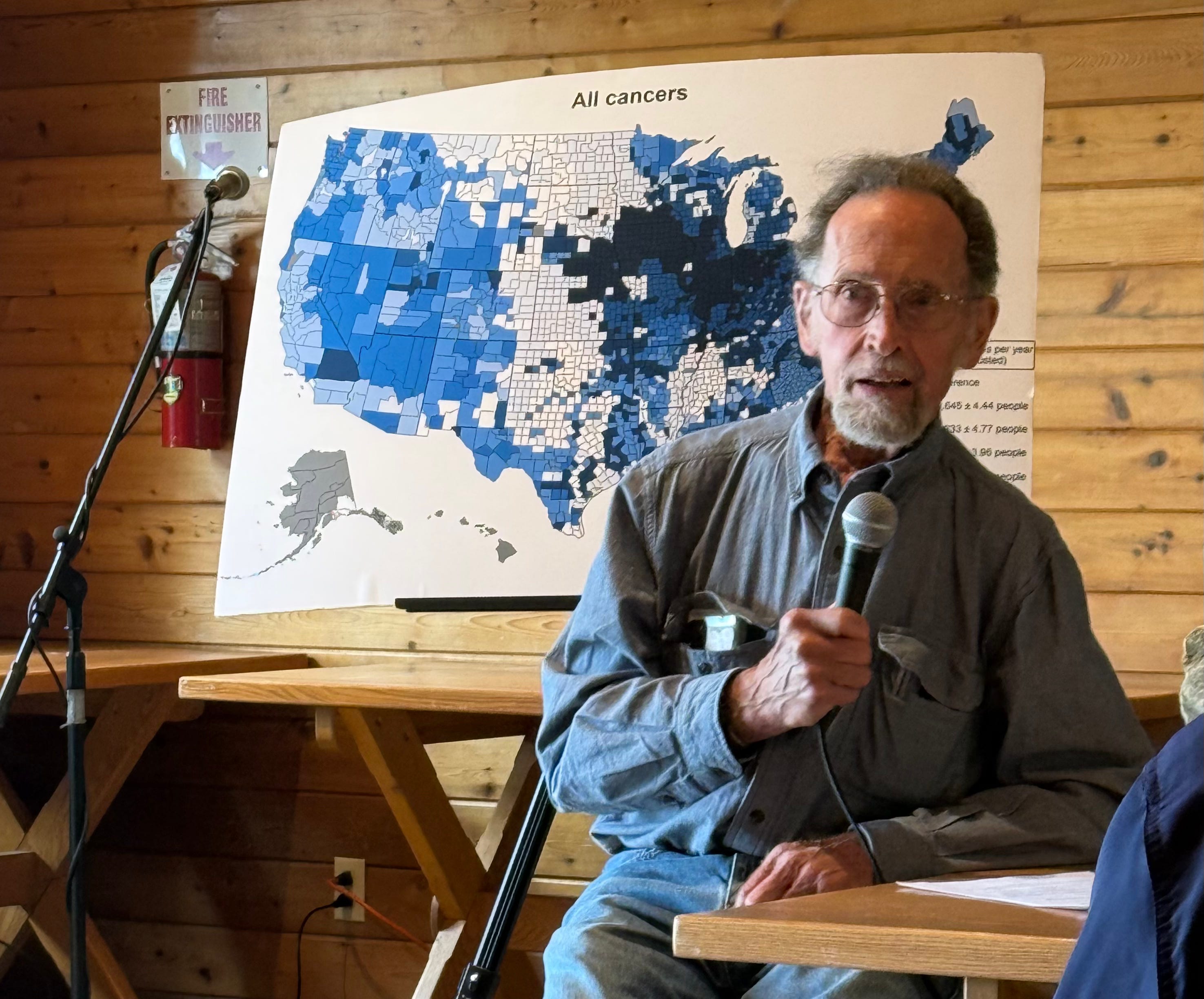
Larry Stone brings his 25 years a journalist covering Iowa’s outdoors to his volunteer work protecting Bloody Run Creek. He sits in front of a mao showing Iowa as Cancer Central. What’s really in that breadbasket?
Water Defender attorney Jim Larew claims that Supreme Beef escapes stricter regulation because DNR allows the operator to put its feed bunks outside the roof overhangs. That apparently makes it an “open-air” feedlot. Most of the cattle see little of the sun.
The group has taken DNR to state and federal court in this and other situations to contest regulatory actions (or inaction) that seem to routinely favor industrial water users. In this case, they are contesting Supreme Beef’s water use permit.
In Southwest Iowa, the Nishnabotna Water Defenders formed in the image and likeness of the Driftless group. They have sued a co-op for a major fertilizer spill that spoiled their river, killing 750,000 fish.
Stone and Larew told the audience of 30 that northeast Iowa water resources also are being challenged by quarries, manure digesters and data centers. Pattison Sand proposed to ship railcars full of Iowa water to drought-stricken states in the American West.
Larew claims the Pattison case in particular put DNR in a pinch. According to state law, water is defined as “public” wealth and requires that water use permits be granted only for “beneficial use.” Larew asserts that DNR rarely turns down an application because the agency interprets the law to mean benefit to the user, not benefit to the public. Since the ultimate water users in the Pattison’s proposal lived in other states, DNR was faced with approving eastern Iowa water for transport through drought-stricken western Iowa to slake the thirst of land and animals in Colorado, Utah and Nevada. Ultimately, the plan was tanked.
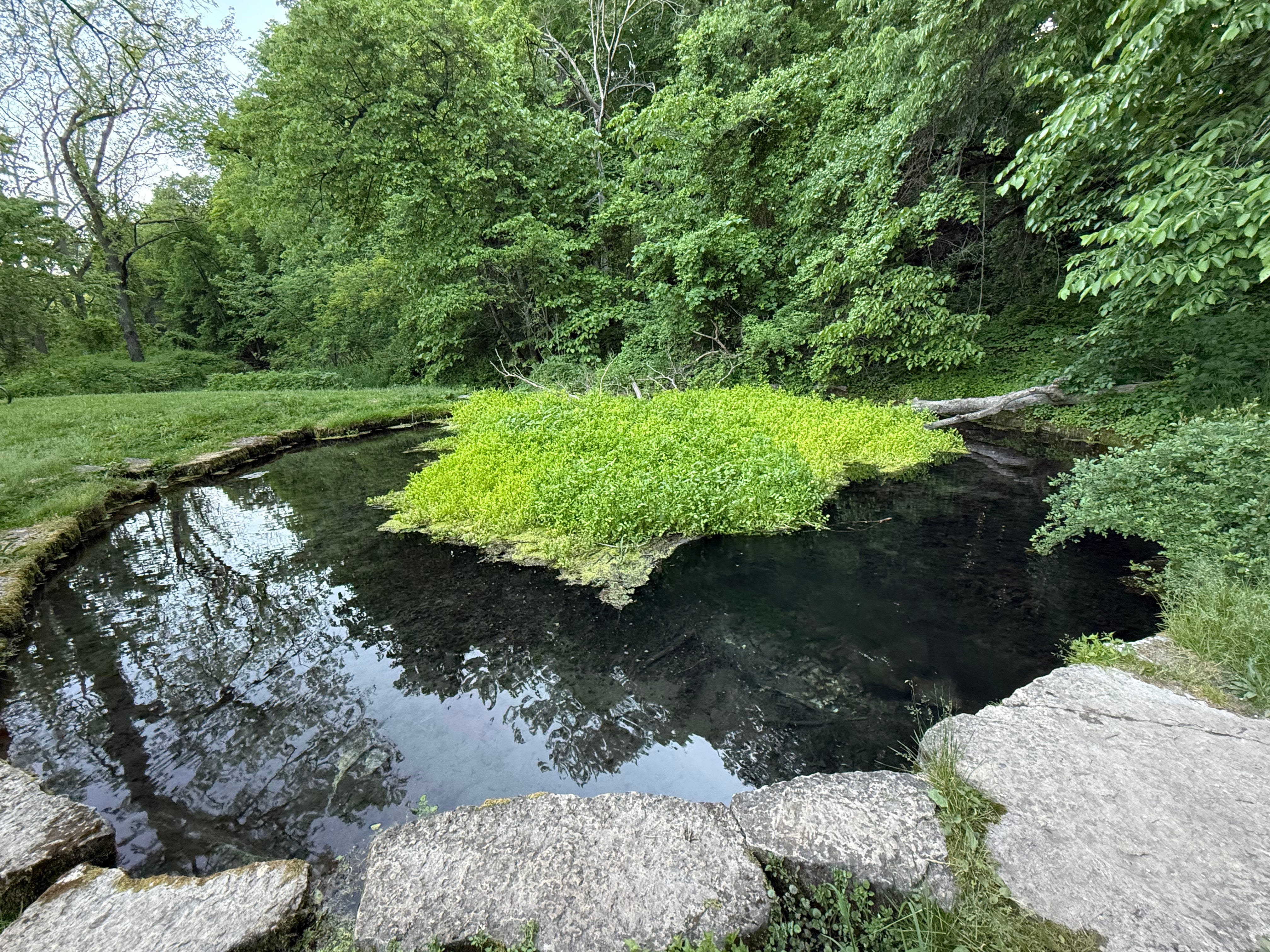
Speaking of Backbone State Park, I never go there without visiting Richmond Springs, which served the old fish hatchery there. The Driftless is home to a plethora of natural springs emerging from the limestone hills to create the natural trout streams. Richmond Springs produces 2000 gallons a minute at a constant 48 degrees.
DNR appears to equate public benefit with the purpose or end product of the water use. If the purpose seems noble and the end product is useful, then the withdrawal permit is approved. Pattison’s noble purpose was putting laid-off workers back on payroll after the frac sand market collapsed.
Now the company wants to quadruple its water withdrawal for its quarry operations to four billion gallons a year. DNR recruited the Iowa Geological Survey to measure the potential impacts. Results of their study will be discussed at a public meeting in Garnavillo on June 9.
What the permit process lacks is a “balancing test,” in which the public interest in water resources carries at least equal weight as the private interests of the user and the knock-on benefits that may accrue to others. The Iowa Utilities Commission uses such a test to determine public convenience and necessity for utility and pipeline permits.
We all know those outcomes can still be controversial. Do I need to say “carbon pipelines?” But future Iowa General Assemblies should require a balancing test when water withdrawal permits are contested. That would allow intervenors to make their case and limit DNR’s practice of reflexively deferring to applicants.
The time also may have arrived for the Legislature to create a water withdrawal fee for using Iowa’s public wealth. A user fee as little as .0001 per gallon (one-one hundredth of a cent) on four billion gallons a year would generate $400,000. Coin like that could finance public projects under a statewide strategic water plan (which Iowa hasn’t had since 1985). Cities, counties, water, wastewater and stormwater utilities, and watershed management authorities could achieve key goals without upping property taxes or padding residential utility bills.
Other changes coming down the pike will be the subject of another DNR public meeting June 17 on a “water supply rulemaking package” covering six chapters of Iowa code, including water use, water supplies, “public notice and education” and “consumer confidence reports.”
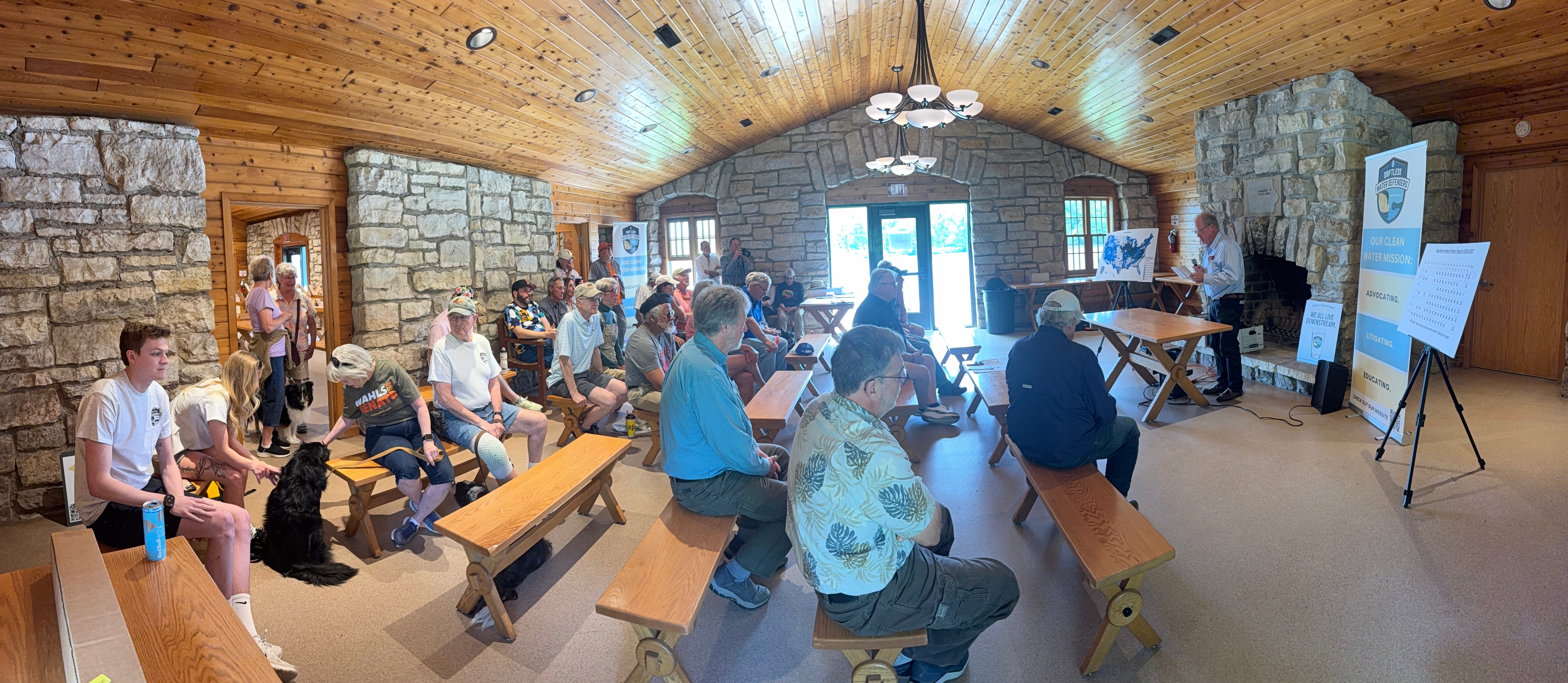
The audience at Backbone State Park.
Back to Backbone, Jim Larew tried to connect the dots on complicated, protracted court proceedings initiated by the Water Defenders that may or may not deliver the results that the “public trust” legal doctrine implies.
To secure that trust, Larew called for a state Constitutional amendment to guarantee Iowans the inalienable right to clean water. (Such an amendment was introduced in the Iowa House this year; I introduced it several times in the past, working with groups like Green Amendments for the Generations.)
Today, I know of one candidate who has made a Constitutional amendment part of their public platform: Chris Jones for Secretary of Agriculture, who calls his campaign a referendum on clean water. If you are aware of others, please let me know.
While state and federal judges are increasingly being implored to rescue democracy, the rule of law and the common good, Larew suggests that the ballot box is where the public interest must ultimately prevail: “Policy got us into this mess. Only policy will get us out.”
