
Take the winning bet
Solar energy: Free for everyone

In the week since Trump and Israel started the bombing in the Middle East, gas prices at the pump have shot up 22 percent in my town (so far). I also expect a bump in my home heating bill for the natural gas costs that utilities pass on to their customers.
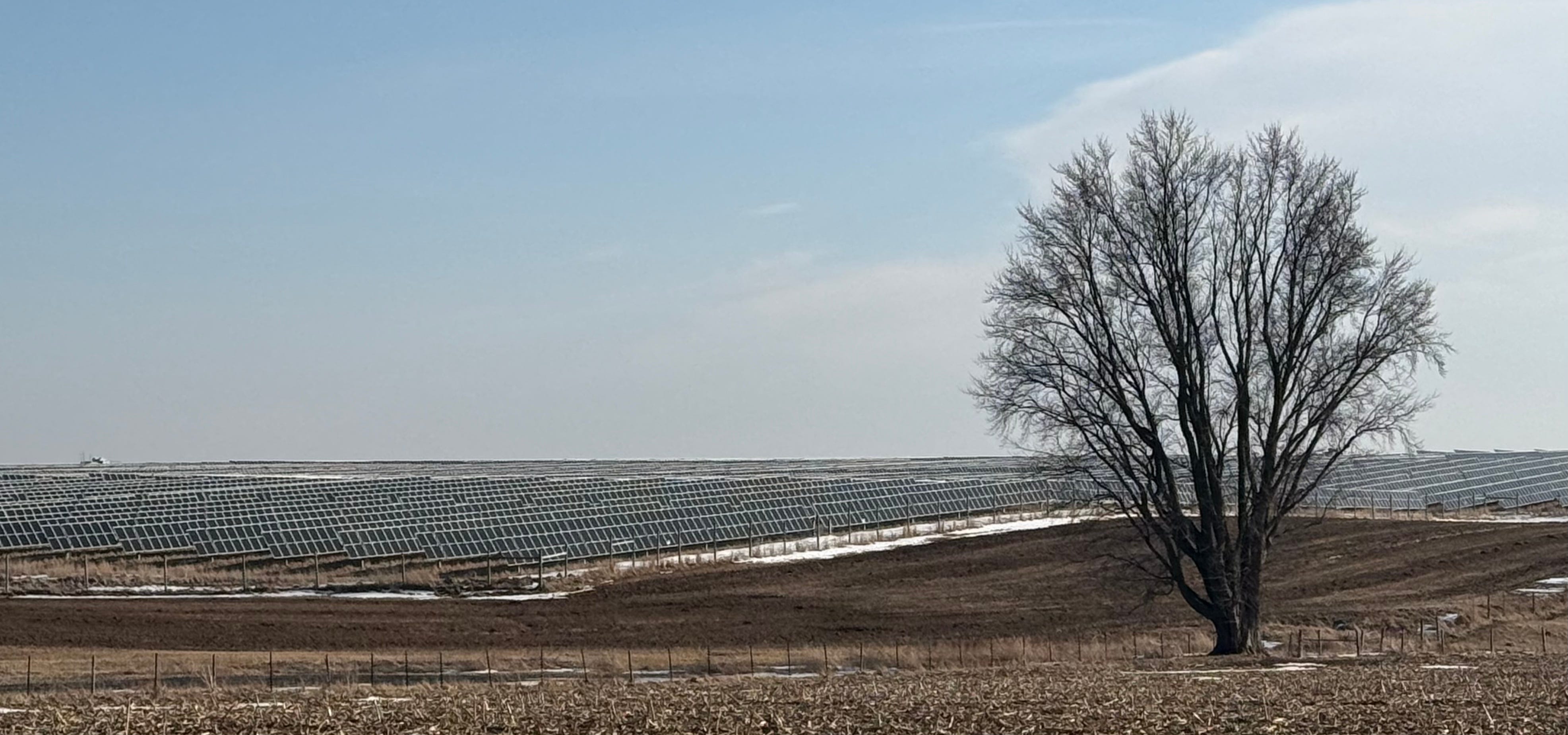
Fall in love with the views that you own. Badger Hollow Solar Farm, Iowa County, Wisconsin.
If it weren’t for the growing power suck from data centers that will drive up everyone’s electric bills, I would test-drive a Chevy Bolt tomorrow. At times like this, people wonder why we aren’t taking better advantage of free and abundant energy from the sun.
By some accounts, more than half of Iowa counties restrict the construction of wind and solar projects with moratoriums and high hurdles like setback requirements. That picture may change if a bill now on the Iowa House debate calendar gains traction.
House File 2580 would set broad state policies and standards that counties will be expected to use for renewable energy projects. If not adopted, the issue won’t be materially addressed until the Iowa Supreme Court rules on a lawsuit that Cerro Gordo County might file against the Iowa Utilities Commission if they don’t get their way.
The Commission is being asked to issue a generating permit for the “Ranger Power Solar Project” on 2,250 acres south of Mason City and Clear Lake. If the IUC grants the permit, the three-member body appointed by the governor would disregard a zoning ordinance adopted by Cerro Gordo county supervisors in 2024 that bans large-scale wind, solar, and battery storage projects in the county.
Other counties are holding their breath waiting for a shoe to drop. In Dubuque County, AES Corporation – one of the country’s largest owner-operators of renewable energy installations -- had agreements with landowners for a project near Holy Cross. Dubuque County Farm Bureau leaders and other producers afraid of losing access to leased farm ground cajoled the board of supervisors into implementing and later extending a moratorium. Meanwhile, the supervisors considered “updating” its renewable energy ordinance with, you guessed it, stiffer (some would say insurmountable) requirements that would effectively ban such projects.
The supervisors justified their moratorium by claiming there were no active projects being delayed, which was only technically true because AES had yet to apply for any permits. AES pulled the plug on its project.
U.S. data published in the Des Moines Register. These lines have now probably crossed over:
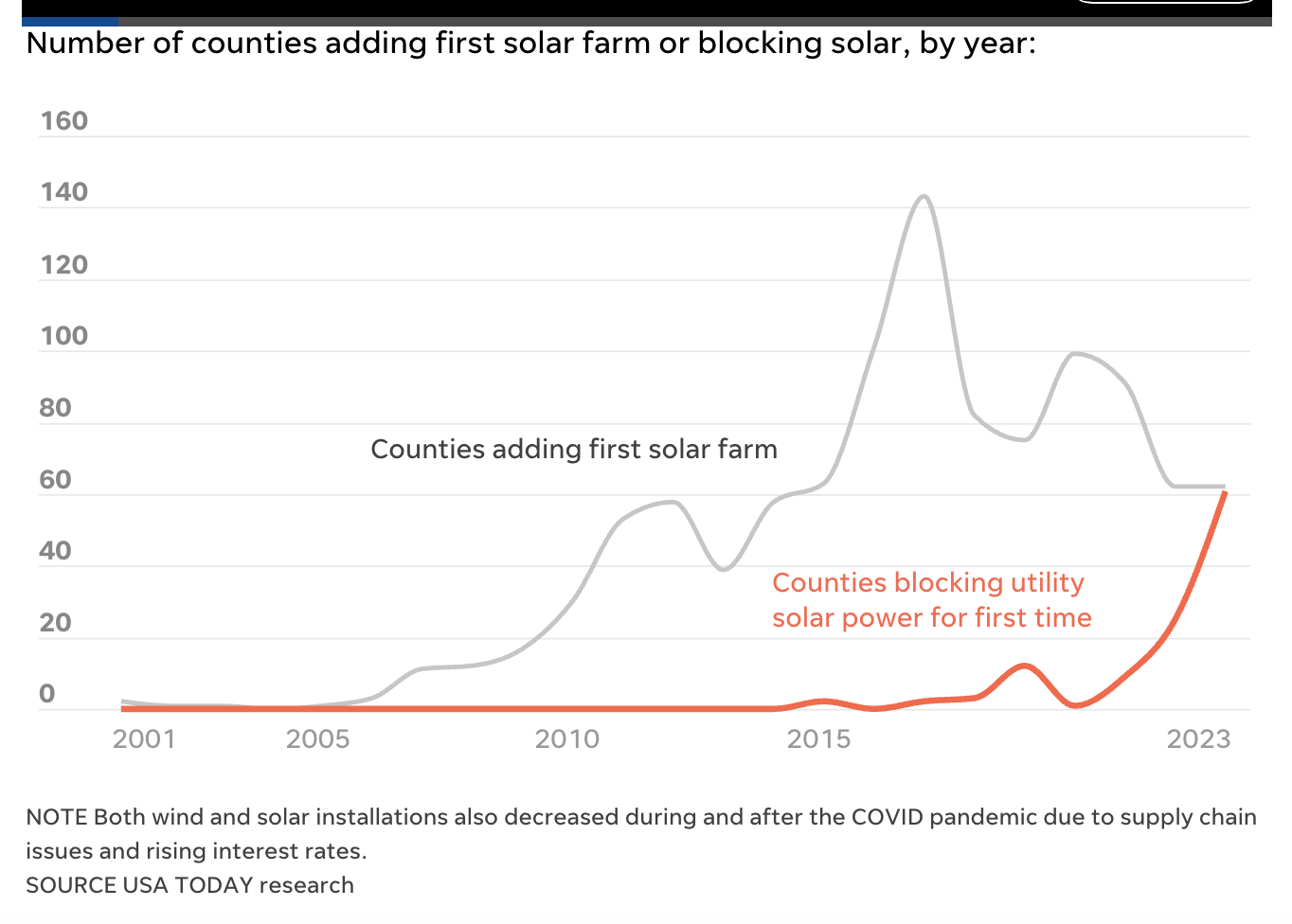
The county moratorium has lapsed. Work on the “update” has stalled. The county is no doubt awaiting instructions from the State Legislature. Or perhaps a lawsuit by private landowners claiming that the county’s exercise of virtual eminent domain was an unconstitutional “taking without just compensation.” Counties would do better to look at best practices like those produced by the Iowa Environmental Council and get on board the gravy train.
Enter State Rep. Shannon Lundgren of Dubuque County. Former chair of the Iowa House Commerce Committee (until her short campaign for Congress), she is floor managing House File 2580 to standardize “the siting and operation of renewable electric power generating facilities.” She wants developers to know that Iowa is “open for business” to meet energy demands in the state.
The bill creates a framework counties can adopt to evaluate solar and wind projects. The bill outlaws eminent domain for the projects and gives individual landowners the right to waive some requirements. If counties choose to maintain moratoriums or non-compliant standards, they must tell taxpayers how much tax revenue they forego by standing in the way and show through a public hearing that county policies are “necessary to prevent adverse impact on the health or safety” of the public.
Energy companies support the bill. Iowa Farm Bureau is against. They will likely remain opposed as long as the Iowa Corngrowers Association and Iowa Soybean Association tell them to be. The two associations make bank through “checkoffs” on every bushel of corn and beans sold. Losing acres seeded to these annual grains strikes their bottom lines. (The corn growers’ opposition to using land to produce renewable energy is odd, given that half of Iowa’s corn is grown to produce the ethanol that is currently no brake on rising gas prices.)
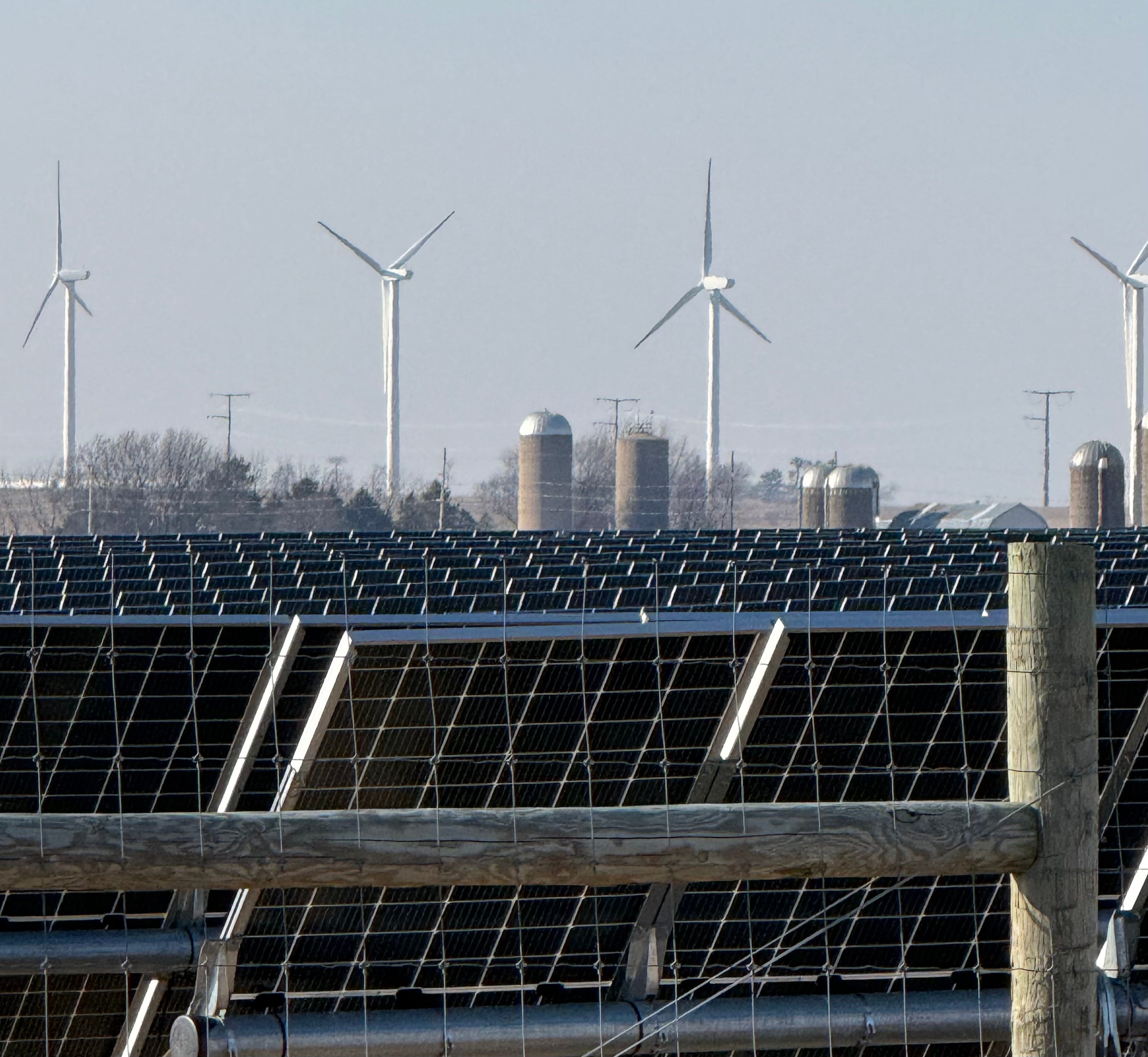
Renewable energy co-existing in harmony with agriculture near Cobb and Monfort, Wisconsin.
Locally, Farm Bureau leaders would ask me as a state legislator if I had “ever been to Cobb, Wisconsin.” Apparently I needed to go to see how “bad” an “industrial” solar facility looked.
Invenergy built the 300-megawatt Badger Hollow Solar Park in Iowa County for We Energies and Madison Gas and Electric on 3,500 acres, including 2,200 acres of panels. On the way to take a look, I passed Alliant Energy’s 1,400-acre, 200-megawatt Grant County Solar Project near Potosi that powers 50,000 homes.
Opponents often say solar panels mar the landscape. A former Dubuque County supervisor once declared: “Don’t fall in love with a view you don’t own.” That was responding to a homeowner who complained that an addition to an existing business would ruin the view out the back window of a house she bought expecting the vista would never change. (Many rural Iowa counties wish they had similar problems posed by business expansion.)
Large livestock producers often defend the odor of their operations with the maxim that “manure smells like money.” Many depend on rented ground to grow the feed their animals need. Some want to stand in the way of other farmers who want to diversify their income with solar lease payments. Those farmers could just as easily say their solar panels look as green as a corn crop.
I asked We Energies and Alliant Energy for information on the rental rates they pay to farmers. I will update this post with such data if I receive it. One farmer leasing to Badger Hollow told me his lease contract requires him to keep the terms secret. UW-Madison Extension reports lease rates ranging from $500 to $1,500 per acre per year, outstripping the net return per acre for every commodity crop. My landowner friend said the report “jives with my understanding.”
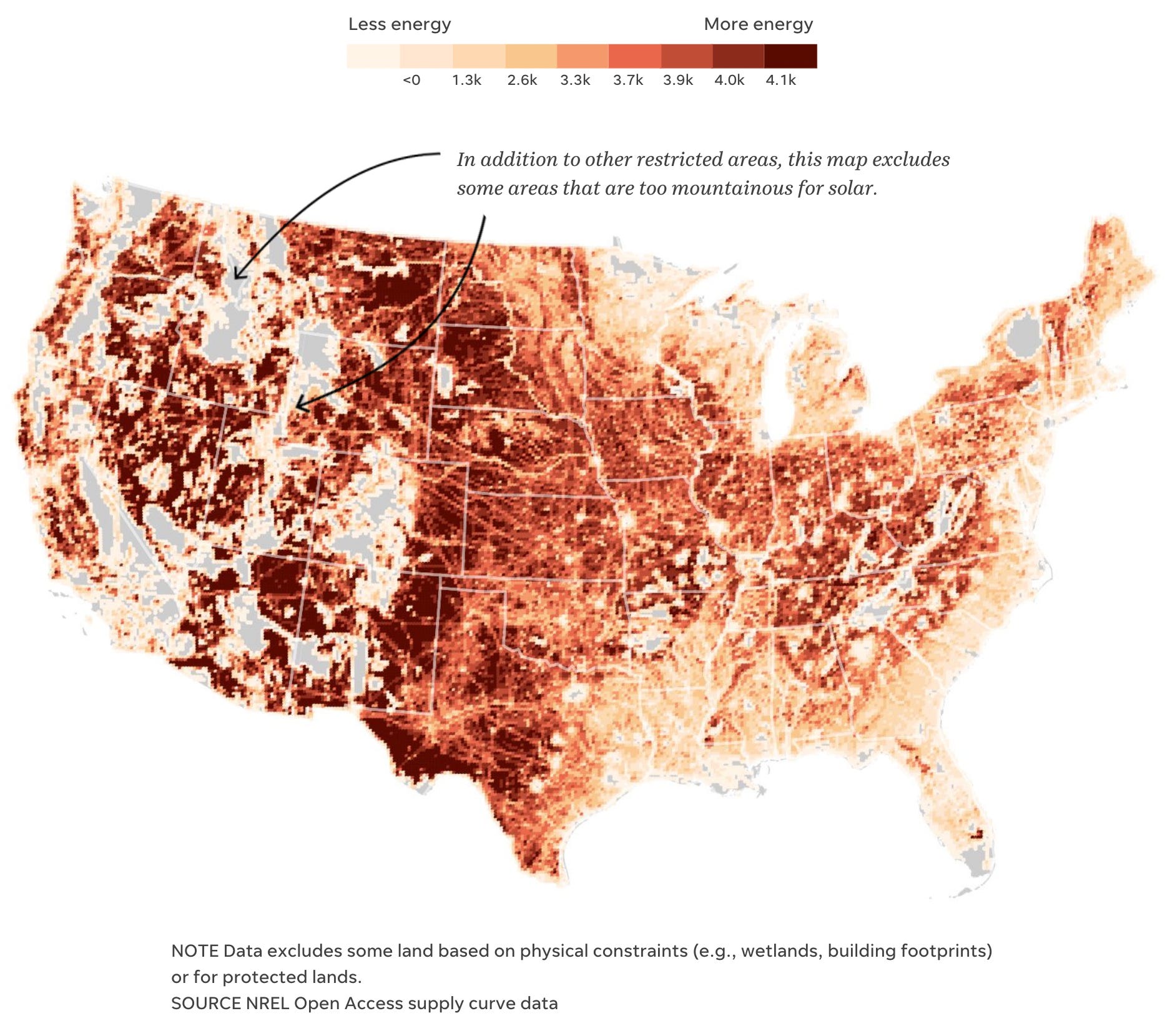
Iowa’s solar footprint looks as good as any state outside the deserts and Great Plains. Per the Des Moines Register, this mao shows the solar energy generation capacity (megawatts) per 11.5km parcel. Data excludes some land based on physical constraints (e.g., wetlands, building footprints) or for protected lands. SOURCE NREL Open Access supply curve data.
In Iowa and Wisconsin, energy companies do not pay property taxes. In Iowa they pay utility replacement generation taxes, which the state distributes back to local governments ($.0006 per kilowatt hour generated). Wisconsin assesses $5,000 per megawatt of capacity, which goes back to counties and townships as “utility aid payments.”
Based on the 396 million kilowatt hours produced by Badger Hollow in 2024, the $5,000 per megawatt of capacity translated to $.0038 per kilowatt, suggesting a tax rate more than six times higher than Iowa (making Iowa a better investment opportunity on that basis).
The 4,900 acres used for the two Wisconsin solar fields previously yielded some $150,000 in annual property taxes (if all acres were prime farm ground). Those projects now generate $2.5 million a year in utility aid assessments. A wind farm in the area with another 110 megawatts of generation capacity accounts for another $550.000.
Wisconsin Department of Revenue records show that, including one-time “conversion charges,” two counties, two towns and one village in southwest Wisconsin raked in $4.15 million in utility aid payments from wind and solar farms in 2025:
Grant County (pop. 51,276): $1,614,433
Iowa County (pop. 23,800): $1.264,522
Village of Potosi (pop. 646): $454,535
Town of Eden (pop. 339): $516,249
Town of Mifflin (pop. 558): $300,734
This document and the graph below detail how the system works in Wisconsin.
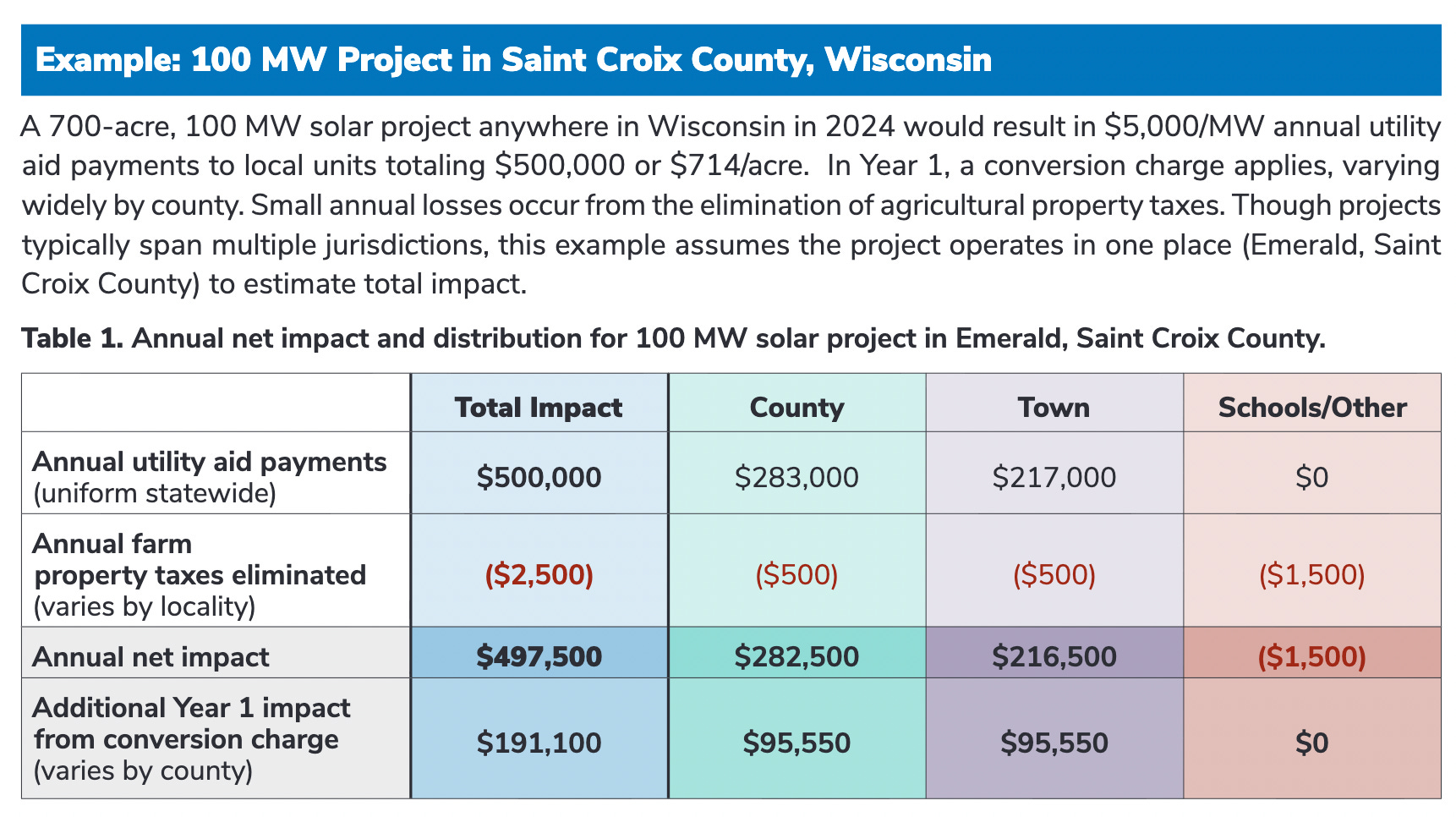
How property taxes and utility aid payments pan out on a typical Wisconsin project. Source: Center for
Empowering Communities, University of Michigan.
In Dubuque County, 3,500 acres of the “best” farm ground (meaning most suitable for corn) might fetch upwards of $250,000 in property taxes. A 300-megawatt “Cobb, Wisconsin” solar farm could yield $350,000 in electric generation replacement taxes on the same acres. That’s the kind of information House File 2580 would require supervisors to tell taxpayers if they continue to block the roads to renewable energy.
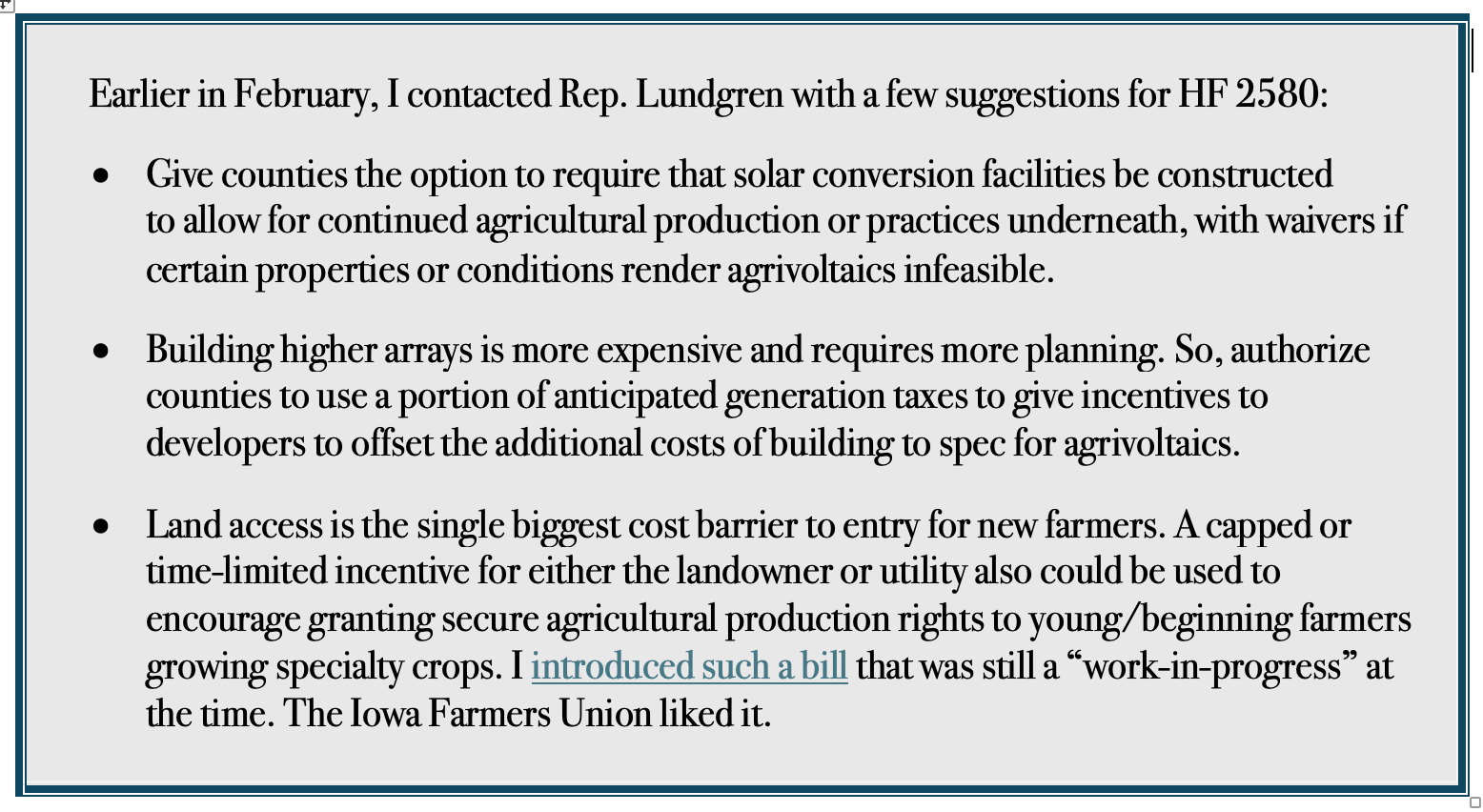
To date, as a public policy matter, Iowa Farm Bureau and other “traditional” ag groups have not acknowledged the potential for “agrivoltaics,” a growing practice that allows both solar power and farm production on the same land, with multiple other benefits. Instead, tax incentives, income protections (“price-loss coverage”), crop insurance subsidies, biofuel mandates and -- as we are seeing – land use restrictions continue to favor commodity agriculture (corn, beans, wheat, cotton, etc.)
Alliant Energy has partnered with both Iowa State University and the University of Wisconsin-Madison to study the potential for agrivoltaics. Iowa Farm Bureau acknowledged the project but did not praise it.
Harvesting the sun while growing food is a proven concept in other states. Check out the Colorado Agrivoltaic Learning Center. Also: The University of Illinois SCAPES Agrivoltaics Project, Auburn University, USDA’s Climate Hubs, Oregon State University and Cornell University, among others.
Grazing animals, pollinator habitat, specialty crop production (think vegetables), water quality and soil regeneration are some of the yields. On the people side: Opportunity for young, beginning and small farmers as well as economic vitality for rural communities. On the market side: A more diverse and sustainable ag economy, local processing jobs, healthier local foods for consumers, lower transportation costs, reduced inputs and less dependence on imports. Possibly some wildlife benefits in there to boot.
This paragraph has been updated since the original posting: As of March 14, House File 2580 has not been scheduled for debate. The bill has to be voted out of the House by March 20. It could also be referred to the Ways and Means Committee to be kept alive. References to tax revenue reporting would justify that. A similar but not identical bill on the Senate debate calendar, SF 2447 — introduced by Majority Leader Mike Klimesh — has simpler but stiffer requirements. It requires counties to adopt state standards if they have a renewable energy siting ordinance and approve projects that comply. The bill prohibits local authorities from banning development on agricultural or industrial ground. The bill also says a county shall not prohibit or limit solar or wind facilities based on corn suitability rating. That bill also faces a March 20 deadline for approval.
Kicking the state policy can down the road will be a full employment opportunity for lawyers. In the meantime, a growing number of farmers want to take the safe bet by leasing their land for solar rather than rolling the dice on corn prices.
Judges will be asked to rule on the rights and powers of utility regulators vs. counties vs. landowners. The private property rights of farmers are likely to prevail if counties fail to make the case that public health, safety and welfare are stronger than energy investor craving for the economic benefits of the free fuel offered by the sun and wind.
Agrivoltaics is a summum bonum of public policy, a win-win for legislators willing to look for the horizon over the sides of their ruts by recognizing diversified land uses that serve multiple values. No one even has to say the word “climate.”
